I really enjoyed the game's unique atmosphere and charming retro aesthetic. You can tell a lot of care went into making it. The only thing that made it difficult for me was the language, since the voices aren't in English, so I struggled to fully understand the story. Still, it's a lovely experience and I hope more international players get to enjoy it too. (๑ > ᴗ < ๑)
Thank you for sharing your experience! I’ve also added instructions on how to switch languages so that every player can enjoy the best possible experience.
I developed it with Claude, but all the game elements were personally reviewed and created by me. Since these are my own memories, it draws from over 30 years of personal stories.
The greatest charm of this game doesn't lie in the storyline of Chapters 1 through 4, but in giving every player the power to design their own memories into Chapter 5 using Skills—this is how I define the 'Second Brain'. I truly believe that your life is a fascinating story to me.
I really appreciate that. Chapter 5 is the heart of Second Brain for me, because it's where the story stops being mine and starts becoming yours. Thanks for seeing that vision.
The greatest charm of this game doesn't lie in the storyline of Chapters 1 through 4, but in giving every player the power to design their own memories into Chapter 5 using Skills — this is how I define the "Second Brain." I truly believe that your life is a fascinating story to me.
Let me explain why Chapter 5 exists at all.
Chapters 1 through 4 are the same for everyone. Yuki, born in 1989, leaves the city, climbs the mountains, sits in the zen room, learns to breathe in the meadow. I wrote every word of it. You walk it exactly as the last player did, and exactly as the next one will. That is the point — it is the shared prologue, the four questions with the blank waveforms, the part where the game is still mine.
Then, after the fourth chapter, the screen asks: "Do you believe in parallel worlds?" And this is the seam of the whole design. Because the honest answer the game is really asking is: are you willing to stop being a reader, and become an author?
Chapter 5 is deliberately left unfinished. Not incomplete by accident — unfinished by design, the way a diary is unfinished until someone writes in it. There is no branching tree I authored for you to pick from, because a set of endings I wrote would still be my endings. Instead, Chapter 5 hands you a Skill: rank your own values, answer for a life lived in reverse, decade by decade, against real pension figures and real costs. The system doesn't retrieve a story — it computes one, from you. What comes out is a life no one has lived before, folded into a single line: SB1-…
That code is the moment the game stops being mine and becomes yours. And here is why the game cannot be complete without it: a game about memory that only ever shows you my memories is a contradiction. "Memory is everyone's most precious asset" — but if the only memories in the game were Yuki's, the sentence would be a lie. The asset it's talking about is yours. So the game leaves a space exactly the shape of your life, and until you step into it, that space stays empty. The four chapters are the frame. Your memory is the painting. A frame around nothing is not a finished work.
This is also why the Memory Packet matters more than any ending I could have written. When you hand your SB1-… code to another person and they enter it, your life plays out on their screen — same code, same life. You didn't complete the game for yourself; you completed a version of it that only exists because you lived it. The next player completes a different one. The game has as many true endings as it has players willing to write themselves into Chapter 5, and not one of them was written by me.
So when I say I believe your life is a fascinating story — I mean it structurally, not as a compliment. The game is literally built to be finished by it. Yuki's journey through four chapters was only ever the invitation. The real work — the fifth chapter, the part that turns "a game about a man named Yuki" into "a game about you" — doesn't exist until you bring your memory to it.
That is the Second Brain: not the one I wrote, but the one that only completes itself when you remember, in it, who you are.
I have commenced a playthrough of the game as a result of the feedback for feedback request. As a result, here are my thoughts:
The first few minutes were involved figuring out how to interact with the UI as it was unintuitive at first. Though this could be because this type of game is far from what I am used to, a redesign of the UI could be of use. In addition, some of the scenery is difficult to identify.
The story is very compelling. I like the attention to detail and the thoughtfulness of the narration and setting, as well as how it connects very well to philosophical themes.
There appears to be no way to view the memory or emotion items appearing in game. Their count is visible through the select menu, but there appears to be no way to individually look at each item. It would be more immersive if this was a feature.
It appears that the game has no discernible branches of story. Right now, there appears to be a single set storyline for the five chapters. Text-based or multiple-choice dialogue options have no effect on the dialogue.
I played the game until chapter 5 and revisited the early chapters. When I played chapter 1 for the second time, there was a link mentioned in the in-game dialogue. I stopped at this point because an external component to the game is a discouragement, and I believe that many would share my sentiment. If the game could be fully progressed solely within the web browser, I would likely have a much better experience in this regard.
Summary: The game concept is very promising with an excellent story and is unlike what I've seen before. It appears that all of the major gameplay elements are already established to some extent, but what would enhance the experience with the game is to add a unified system that is straightforward to interact with that adequately links together all of the game's elements. In addition, an enhanced storyline would give the game additional replay value. (I'm not sure what's past chapter 5, but having everything on one tab will likely improve retention). Provided that these improvements are implemented, I would say this game is in the right direction to be a unique and unprecedented experience.
Thank you — this is the most thorough feedback I've received, and you clearly played with real attention. Let me answer each point honestly, because several of them touch the core of what the game is trying to be.
On the UI and unclear scenery — You're right, and I won't defend it. The interaction model asks you to walk up to an object and press A, which isn't obvious on first contact, and the four-shade-green palette makes some objects hard to read. This is the fairest criticism and the first thing I'll fix. A short "how to interact" prompt at the start and clearer object outlines would remove most of the friction you hit.
On the story and themes — Thank you. That's the part I care about most, so it means a lot that it landed.
On not being able to view collected memories/emotions individually — This is a real gap. Right now the SELECT menu only shows a count. You're right that being able to open each of the 75 emotions and 30 zen phrases you've collected — to actually re-read the one that matched a moment you lived — would make the collection feel like yours instead of a number. I'm adding an individual gallery view. Good catch.
On "no discernible branches" — This is the most important point, and here I have to both agree and reframe, because it reveals something the game hasn't communicated well.
You're correct that Chapters 1–4 are a single fixed storyline — dialogue choices there don't fork the narrative. That's intentional: those four chapters are the shared prologue everyone walks through.
But the actual branching lives in Chapter 5, and it works differently from what "multiple-choice dialogue" usually means. Chapter 5 isn't a pre-written tree of endings I authored. It's a generative system — think of it as a Skill that composes your own memory-story from your inputs:
In Life-Reverse, you rank your own values and answer questions about a life lived in reverse, decade by decade. The system computes a specific life from those inputs — pension timing, education paths, the roads not taken — using real-world data. Different inputs produce a genuinely different reckoning.
That result compresses into a Memory Packet — a code like SB1-…. This is the branch. It isn't one of N endings I wrote; it's yours, generated from your choices.
Hand that code to another player, they enter it, and your life replays on their screen. Same code, same life. Different code, different life.
So the branching you were looking for is real — it's just not in the Chapters 1–4 dialogue. It's the whole engine of Chapter 5: you don't pick from my branches, you author your own memory-story, and it becomes a shareable artifact. The reason it didn't read as "branching" is almost certainly the UI and framing problem you already identified — the game never makes clear that Chapter 5 is the branching system. That's on me to communicate, and your feedback just told me exactly where it breaks.
On the external link in Chapter 1 — This is the single most valuable thing you flagged, and you're right without qualification. Sending a player out of the browser mid-story is a retention killer, and I'd bet you're speaking for many who simply closed the tab there. The entire experience should live on one tab. I'm removing that external dependency and bringing whatever it pointed to inside the game. Thank you for stopping there and telling me why — that "why" is worth more than a bug report.
On your summary — You've diagnosed it precisely: the major elements exist, but they need one unified, legible system that ties them together and stays inside the browser. That's the right priority, and it's now my roadmap:
A clearer interaction model + object readability (your point 1)
An individual gallery for memories/emotions (your point 3)
Surfacing Chapter 5's generative branching so it reads as branching (your point 4)
Everything on one tab — no external links (your point 5)
For what it's worth: what's past Chapter 5 is exactly the thing you're asking for — the Memory Packet system that turns your single playthrough into something you can regenerate and hand to others. Your instinct that "keeping everything on one tab will improve retention" is correct, and it's the fix I'm prioritizing first.
Thank you again. You didn't just report problems — you handed me the order to fix them in. That's rare, and it genuinely helps.
The greatest charm of this game doesn't lie in the storyline of Chapters 1 through 4, but in giving every player the power to design their own memories into Chapter 5 using Skills—this is how I define the 'Second Brain'. I truly believe that your life is a fascinating story to me.
Im gonna be completely honest. Im 10 years of age and i thought this would just be another trash anime game. Until i played it. My eyes were glued on the screen for hours playing this game. Its too fun! Please, continue making more games! Can you also check out my game that i made using python? I released it a couple days ago. BUT YOU MUST HAVE PYTHON AND PYGAME INSTALLED TO RUN IT!!! Anyways ima continue playing this game. Oh quick edit! Can I maybe be a programmer for your future updates/ games?
Thank you for your love for this game. The design of this game is to allow everyone to become a programmer and design your own unique storyline. The method is through Skills; once loaded by the AI, you can start designing.
This skill is intended to enhance the interactive experience of the game "SECONDBRAIN," allowing players to develop their own unique memories through the Skill.https://skillhub.cn/skills/rgb
← Return to Game Boy Game
Comments
Log in with itch.io to leave a comment.
Well, It's a very niche game. It's not my type. Maybe it fits to gameboy players. I didn't understand what I supposed to do.
thank you for your comment
painted eggshell
great game. Really fun to play
Thank you so much!
I really enjoyed the game's unique atmosphere and charming retro aesthetic. You can tell a lot of care went into making it. The only thing that made it difficult for me was the language, since the voices aren't in English, so I struggled to fully understand the story. Still, it's a lovely experience and I hope more international players get to enjoy it too. (๑ > ᴗ < ๑)
Just click the "Select" button to switch to English mode—give it a try!
Just click the "Select" button to switch to English mode—give it a try!
ah, my mistake. i didn't figure out how to select it. okay, all clear now.
Thank you for sharing your experience! I’ve also added instructions on how to switch languages so that every player can enjoy the best possible experience.
How long did it take you to develop this, and how did you do it? unity or Godot? etc.
I developed it with Claude, but all the game elements were personally reviewed and created by me. Since these are my own memories, it draws from over 30 years of personal stories.
The greatest charm of this game doesn't lie in the storyline of Chapters 1 through 4, but in giving every player the power to design their own memories into Chapter 5 using Skills—this is how I define the 'Second Brain'. I truly believe that your life is a fascinating story to me.
I really appreciate that. Chapter 5 is the heart of Second Brain for me, because it's where the story stops being mine and starts becoming yours. Thanks for seeing that vision.
The greatest charm of this game doesn't lie in the storyline of Chapters 1 through 4, but in giving every player the power to design their own memories into Chapter 5 using Skills — this is how I define the "Second Brain." I truly believe that your life is a fascinating story to me.
Let me explain why Chapter 5 exists at all.
Chapters 1 through 4 are the same for everyone. Yuki, born in 1989, leaves the city, climbs the mountains, sits in the zen room, learns to breathe in the meadow. I wrote every word of it. You walk it exactly as the last player did, and exactly as the next one will. That is the point — it is the shared prologue, the four questions with the blank waveforms, the part where the game is still mine.
Then, after the fourth chapter, the screen asks: "Do you believe in parallel worlds?" And this is the seam of the whole design. Because the honest answer the game is really asking is: are you willing to stop being a reader, and become an author?
Chapter 5 is deliberately left unfinished. Not incomplete by accident — unfinished by design, the way a diary is unfinished until someone writes in it. There is no branching tree I authored for you to pick from, because a set of endings I wrote would still be my endings. Instead, Chapter 5 hands you a Skill: rank your own values, answer for a life lived in reverse, decade by decade, against real pension figures and real costs. The system doesn't retrieve a story — it computes one, from you. What comes out is a life no one has lived before, folded into a single line:
SB1-…That code is the moment the game stops being mine and becomes yours. And here is why the game cannot be complete without it: a game about memory that only ever shows you my memories is a contradiction. "Memory is everyone's most precious asset" — but if the only memories in the game were Yuki's, the sentence would be a lie. The asset it's talking about is yours. So the game leaves a space exactly the shape of your life, and until you step into it, that space stays empty. The four chapters are the frame. Your memory is the painting. A frame around nothing is not a finished work.
This is also why the Memory Packet matters more than any ending I could have written. When you hand your
SB1-…code to another person and they enter it, your life plays out on their screen — same code, same life. You didn't complete the game for yourself; you completed a version of it that only exists because you lived it. The next player completes a different one. The game has as many true endings as it has players willing to write themselves into Chapter 5, and not one of them was written by me.So when I say I believe your life is a fascinating story — I mean it structurally, not as a compliment. The game is literally built to be finished by it. Yuki's journey through four chapters was only ever the invitation. The real work — the fifth chapter, the part that turns "a game about a man named Yuki" into "a game about you" — doesn't exist until you bring your memory to it.
That is the Second Brain: not the one I wrote, but the one that only completes itself when you remember, in it, who you are.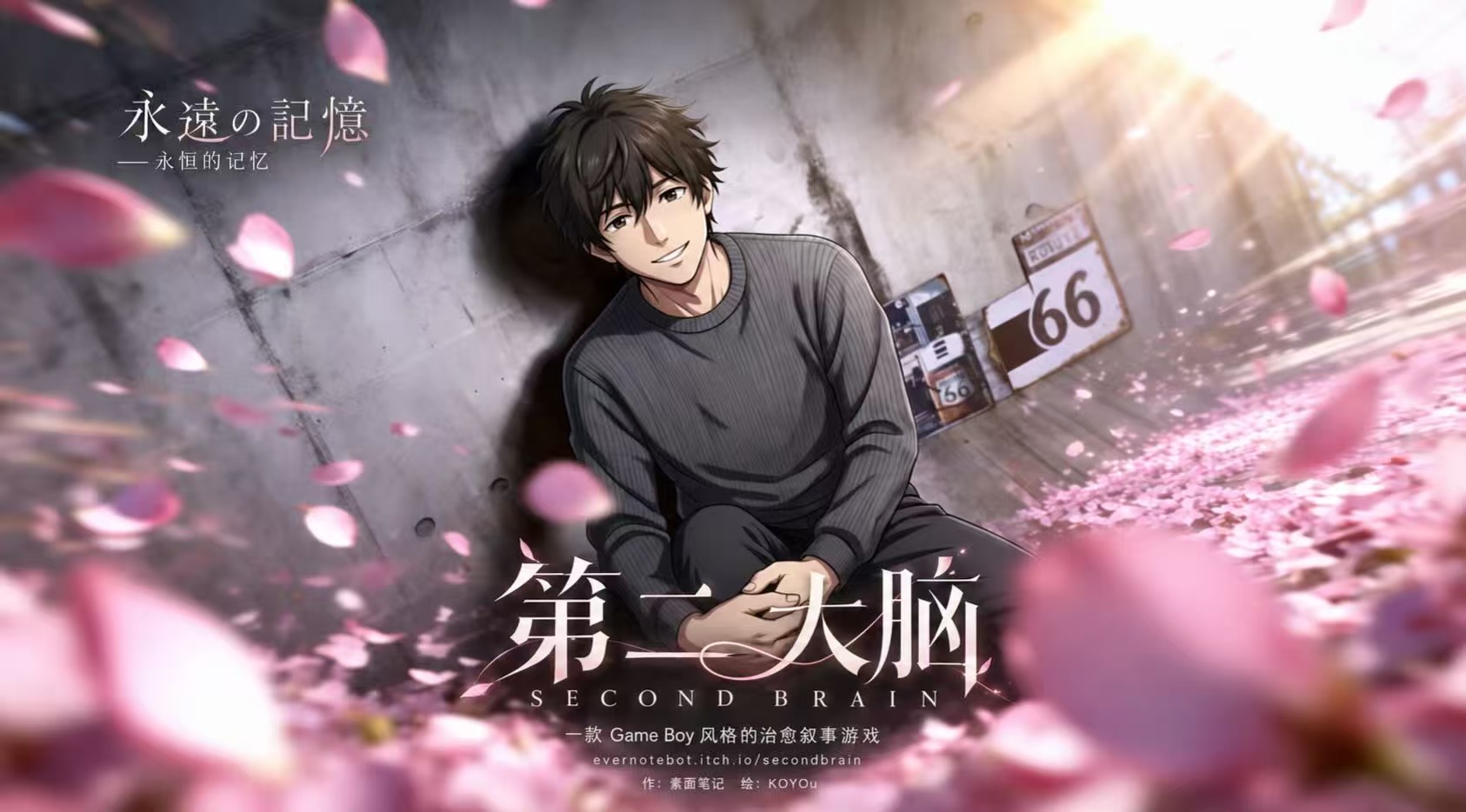
Hello,
I have commenced a playthrough of the game as a result of the feedback for feedback request. As a result, here are my thoughts:
Summary: The game concept is very promising with an excellent story and is unlike what I've seen before. It appears that all of the major gameplay elements are already established to some extent, but what would enhance the experience with the game is to add a unified system that is straightforward to interact with that adequately links together all of the game's elements. In addition, an enhanced storyline would give the game additional replay value. (I'm not sure what's past chapter 5, but having everything on one tab will likely improve retention). Provided that these improvements are implemented, I would say this game is in the right direction to be a unique and unprecedented experience.
Thank you — this is the most thorough feedback I've received, and you clearly played with real attention. Let me answer each point honestly, because several of them touch the core of what the game is trying to be.
On the UI and unclear scenery — You're right, and I won't defend it. The interaction model asks you to walk up to an object and press A, which isn't obvious on first contact, and the four-shade-green palette makes some objects hard to read. This is the fairest criticism and the first thing I'll fix. A short "how to interact" prompt at the start and clearer object outlines would remove most of the friction you hit.
On the story and themes — Thank you. That's the part I care about most, so it means a lot that it landed.
On not being able to view collected memories/emotions individually — This is a real gap. Right now the SELECT menu only shows a count. You're right that being able to open each of the 75 emotions and 30 zen phrases you've collected — to actually re-read the one that matched a moment you lived — would make the collection feel like yours instead of a number. I'm adding an individual gallery view. Good catch.
On "no discernible branches" — This is the most important point, and here I have to both agree and reframe, because it reveals something the game hasn't communicated well.
You're correct that Chapters 1–4 are a single fixed storyline — dialogue choices there don't fork the narrative. That's intentional: those four chapters are the shared prologue everyone walks through.
But the actual branching lives in Chapter 5, and it works differently from what "multiple-choice dialogue" usually means. Chapter 5 isn't a pre-written tree of endings I authored. It's a generative system — think of it as a Skill that composes your own memory-story from your inputs:
SB1-…. This is the branch. It isn't one of N endings I wrote; it's yours, generated from your choices.So the branching you were looking for is real — it's just not in the Chapters 1–4 dialogue. It's the whole engine of Chapter 5: you don't pick from my branches, you author your own memory-story, and it becomes a shareable artifact. The reason it didn't read as "branching" is almost certainly the UI and framing problem you already identified — the game never makes clear that Chapter 5 is the branching system. That's on me to communicate, and your feedback just told me exactly where it breaks.
On the external link in Chapter 1 — This is the single most valuable thing you flagged, and you're right without qualification. Sending a player out of the browser mid-story is a retention killer, and I'd bet you're speaking for many who simply closed the tab there. The entire experience should live on one tab. I'm removing that external dependency and bringing whatever it pointed to inside the game. Thank you for stopping there and telling me why — that "why" is worth more than a bug report.
On your summary — You've diagnosed it precisely: the major elements exist, but they need one unified, legible system that ties them together and stays inside the browser. That's the right priority, and it's now my roadmap:
For what it's worth: what's past Chapter 5 is exactly the thing you're asking for — the Memory Packet system that turns your single playthrough into something you can regenerate and hand to others. Your instinct that "keeping everything on one tab will improve retention" is correct, and it's the fix I'm prioritizing first.
Thank you again. You didn't just report problems — you handed me the order to fix them in. That's rare, and it genuinely helps.
The greatest charm of this game doesn't lie in the storyline of Chapters 1 through 4, but in giving every player the power to design their own memories into Chapter 5 using Skills—this is how I define the 'Second Brain'. I truly believe that your life is a fascinating story to me.
Nice game! I like the atmosphere and GameBoy-like style of the game.
Thank you bro
nice game bro
thank you!
Time fades, but memories remain our most precious treasure.
If you love Japanese anime and game, this is for you! don't miss this!
If you love Japanese anime and game, this is for you! don't miss this!
Im gonna be completely honest. Im 10 years of age and i thought this would just be another trash anime game. Until i played it. My eyes were glued on the screen for hours playing this game. Its too fun! Please, continue making more games! Can you also check out my game that i made using python? I released it a couple days ago. BUT YOU MUST HAVE PYTHON AND PYGAME INSTALLED TO RUN IT!!! Anyways ima continue playing this game. Oh quick edit! Can I maybe be a programmer for your future updates/ games?
Thanks.
Daily Sudoku is also a lot of fun. Give it a try!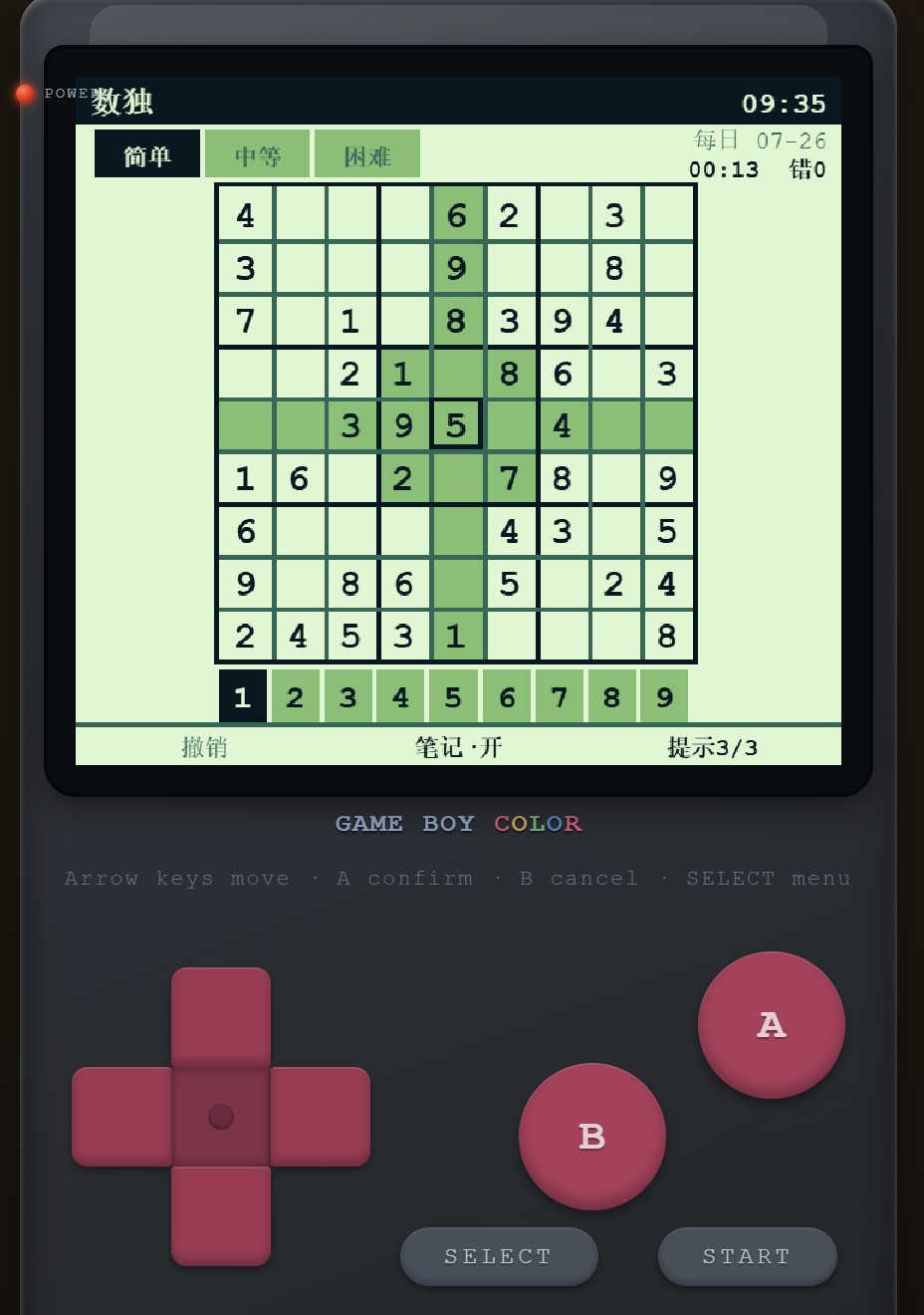
Ok! I will check it out! Can i be a programmer pls?
Thank you for your love for this game. The design of this game is to allow everyone to become a programmer and design your own unique storyline. The method is through Skills; once loaded by the AI, you can start designing.
Prompt
Please install the 'rgb' skill according to https://skillhub.cn/install/skillhub.md
ok I installed it and read it. How do i start working?
Use/call the Skill within your AI tool, and then tell it what storyline you want to set up just like in a normal conversation.
This skill is intended to enhance the interactive experience of the game "SECONDBRAIN," allowing players to develop their own unique memories through the Skill.https://skillhub.cn/skills/rgb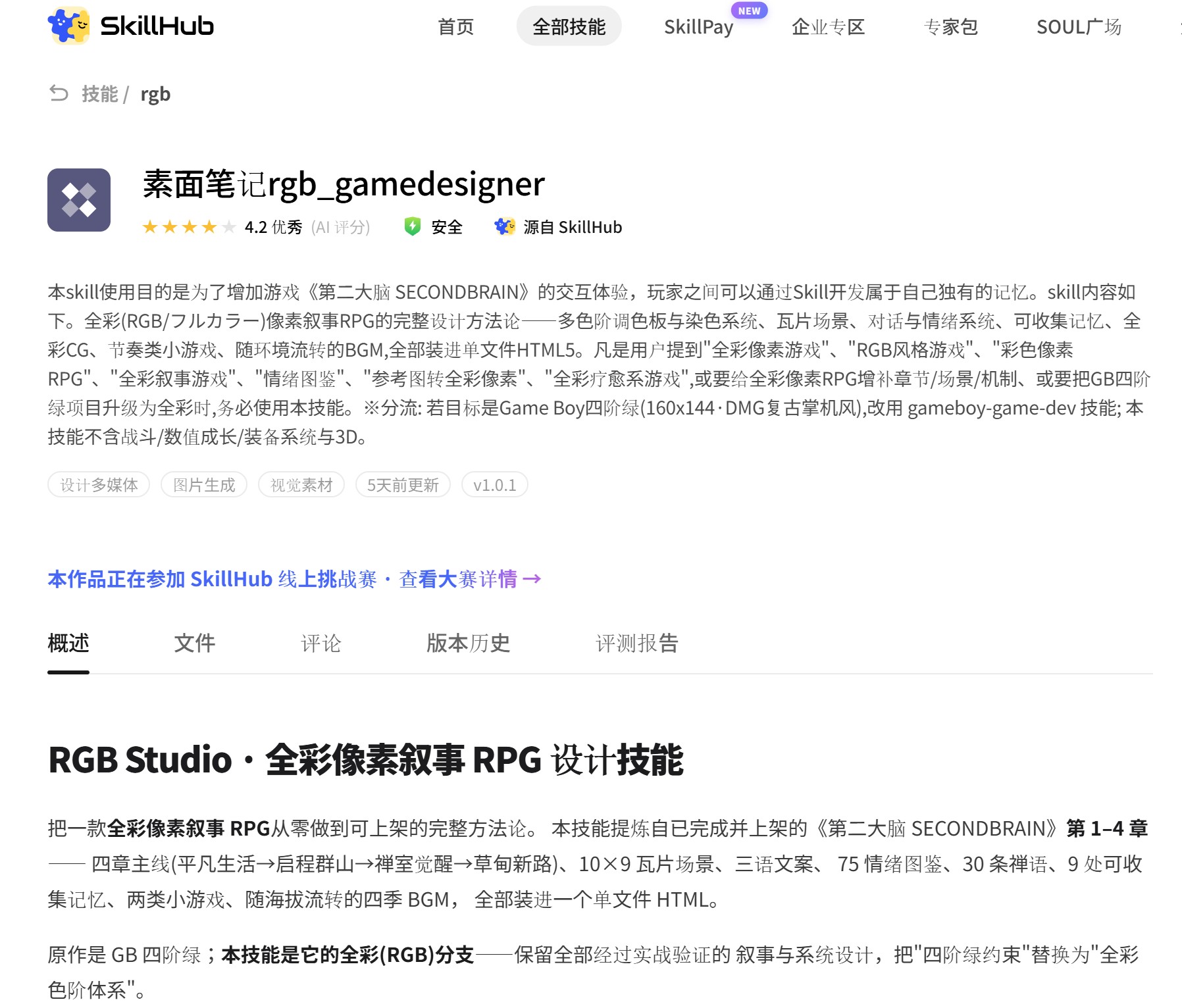
Ep.2 | Loved Ones, Deepest Wounds
Ep.1 | Your Memory Is Your Most Valuable Asset
I always believed that games can record people’s life and spread love. Time fades, but memories remain our most precious treasure.